skip to content

ADHD or Anxiety? How to Tell the Difference in Adults

Reading Time 9 mins

Rohan is 28 and works as a software developer in a IT company. In team meetings, his mind goes blank. He misses deadlines, loses his keys and wallet, and lies awake at night with a racing mind. His doctor said, "It's just anxiety. Try to relax." He tried. He did breathing exercises and cut down on coffee. Yet nothing changed in his daily struggle.
What if the problem is not only anxiety? And what if someone else, who has been told they have ADHD, is really struggling with constant worry?

This article explains how ADHD and anxiety are alike, how they are different, what Indian research says, and when to seek help.

At Mitsu across our clinics in Mumbai, our team of mental health professionals who work with adults navigating focus, overwhelm, and emotional wellbeing often meet clients who have been treated for one thing while the real struggle is another, or both.


Key Takeways

• ADHD and anxiety can look very similar, with poor focus, restlessness, bad sleep, and feeling overwhelmed. But the reasons behind them are different.
• In ADHD, attention is hard to control. In anxiety, worry and fear take over the mind and leave no room for attention.
• Many adults have both, and treating only one may leave the daily struggle unchanged.
• Recent Indian studies show that adult ADHD symptoms are common in young adults, yet often go unrecognised.
• A proper assessment by a qualified professional is the only way to know what is going on.

Why ADHD and Anxiety are so often confused

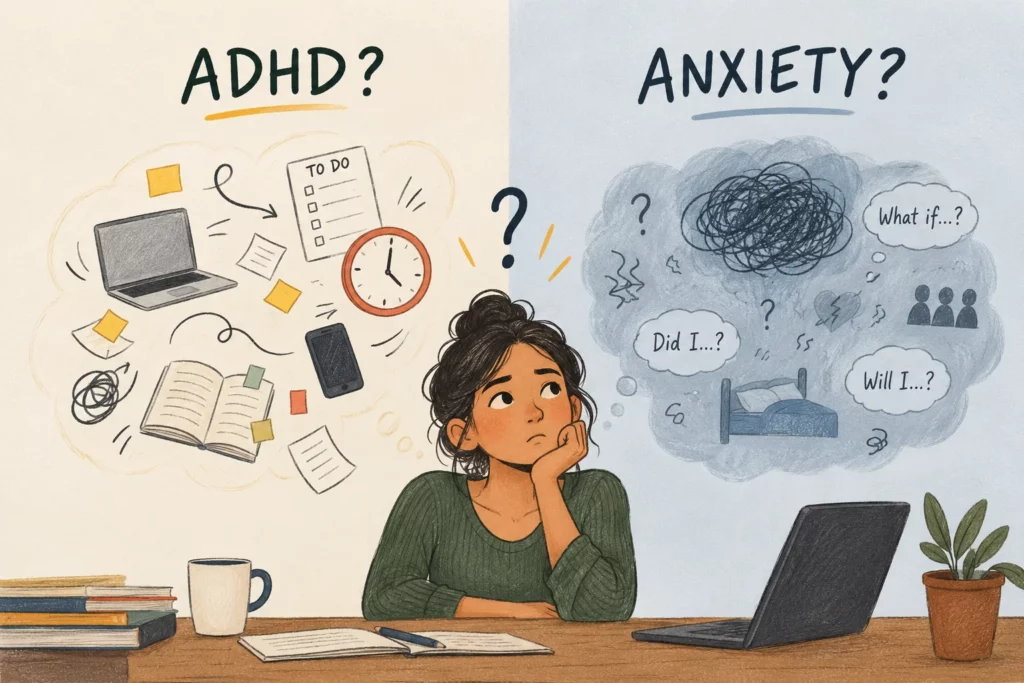
Both ADHD and anxiety can cause trouble concentrating, restlessness, poor sleep, irritability, and a feeling of being overwhelmed. From the outside, and even from the inside, they can look the same.
But similar-looking symptoms can have different causes. And the cause decides what actually helps.
Many adults also have both at the same time. This article is meant to help you understand, not to diagnose yourself.

The key differences

Why you cannot focus with ADHD and attention is hard to steer. Your mind wanders even when you care about the task, even when nothing is wrong, and even when you are calm. It is like a TV with a remote that keeps changing channels on its own.

With anxiety, worry takes over the mind. You cannot focus because part of your brain is busy with "What if I fail?" or "What will they think?" Once the fear settles, your focus often returns.
Sneha is 31 and works in marketing in Mumbai. Before every presentation, her heart races and she reads her slides again and again, unable to take them in. But on a relaxed Sunday, she can read a whole book without trouble. That pattern points more towards anxiety.

ADHD vs Anxeity

ADHDAnxiety
Where restlessness comes froma need for movement or stimulation. You fidget, pace, switch between tasks, or feel bored very quickly.nervous tension. You feel on edge, with physical signs like a racing heart, a tight chest, sweaty palms, or a knot in the stomach.
Why tasks get delayed or avoidedit is hard to start, plan, and finish. You may want to do it, but your brain does not "switch on". Often there is no fear attached, just a stuck feeling.you avoid the task because of fear of failing, being judged, or getting it wrong. Sometimes you over-prepare to feel safe.
Forgetfulness and racing thoughtsyou forget because the information never settled in, or you lose track of time. At night, thoughts jump from one topic to another.you forget because your mind is full of worries. At night, the same fearful thoughts go round and round.
When it startedt begins in childhood and is lifelong, even if nobody noticed. For a diagnosis, professionals look for signs from before the age of 12.it can begin at any age, often during a stressful time or a big life change, though it can also start early.

ADHD

Where restlessness comes from
a need for movement or stimulation. You fidget, pace, switch between tasks, or feel bored very quickly.
Why tasks get delayed or avoided
it is hard to start, plan, and finish. You may want to do it, but your brain does not "switch on". Often there is no fear attached, just a stuck feeling.
Forgetfulness and racing thoughts
you forget because the information never settled in, or you lose track of time. At night, thoughts jump from one topic to another.
When it started
t begins in childhood and is lifelong, even if nobody noticed. For a diagnosis, professionals look for signs from before the age of 12.

Anxiety

Where restlessness comes from
nervous tension. You feel on edge, with physical signs like a racing heart, a tight chest, sweaty palms, or a knot in the stomach.
Why tasks get delayed or avoided
you avoid the task because of fear of failing, being judged, or getting it wrong. Sometimes you over-prepare to feel safe.
Forgetfulness and racing thoughts
you forget because your mind is full of worries. At night, the same fearful thoughts go round and round.
When it started
it can begin at any age, often during a stressful time or a big life change, though it can also start early.

When It Is Both

ADHD and anxiety very often go hand in hand. A 2026 international review which pooled 58 studies, found that adults with ADHD had clearly higher anxiety scores than adults without ADHD.
There is a simple reason. Imagine missing deadlines, forgetting plans, and being told you are careless, year after year. You would start to worry about letting people down. Over time, anxiety grows on top of the ADHD.

Kavita is 38 and lives in Lucknow with her husband and two children. She has been treated for anxiety for years. The medicine and therapy helped her worry, but she still forgets school forms, loses track of time, and cannot finish what she starts. Later, an assessment showed that she had ADHD along with anxiety. Treating only one had left half of the problem untouched.
Having both is common, and it is manageable once both are understood.

Why this often gets misread, especially in india

In many Indian homes and workplaces, adults hear things like "Tension mat lo", "Overthinking mat karo", "Dhyan nahi deta", or "Tum bahut lazy ho." Focus problems are seen as a lack of effort. Restlessness is seen as nervousness.
Pressure around marks, jobs, marriage, and family expectations can also cause or hide both conditions. So it is easy to say, "It is just stress."
Many people also describe distress through the body, such as headaches, stomach trouble, or constant tiredness, rather than saying they cannot focus or feel worried.
Add to this the limited awareness of adult ADHD, and anxiety becomes the label most likely to be given. Many adults are treated for anxiety for years before anyone asks about ADHD.

What the research says

Indian studies that compare ADHD and anxiety side by side are still few. But some recent studies show how common ADHD symptoms are among young Indian adults, and how easily they could be mistaken for stress or anxiety. Anxiety often comes along with adult ADHD.

In a recent review published in Frontiers in Psychiatry in 2026, researchers from Yenepoya University in Karnataka went through the Indian research on ADHD. They found that anxiety and depression are among the most common conditions seen alongside adult ADHD, and that this overlap makes diagnosis harder. They also called for care that looks at the whole picture, not just one label.

Many adults with ADHD have another condition too. A 2025 review of Indian studies on adult ADHD, by Mishra and colleagues, found that in clinic settings adult ADHD often comes with other mental health conditions, including anxiety, depression, and substance use. One Indian clinic study it describes found that about 8 in 10 adults with ADHD had at least one such condition. So if anxiety is the only label you have been given, it may be worth asking whether ADHD is also part of the picture.

What else can look like this?

Poor focus, restlessness, and overwhelm do not always mean ADHD or anxiety. Many other things can cause them, including:
• Depression
• Past trauma or long-term stress
• Poor or broken sleep, including sleep apnoea
• Burnout
• Thyroid problems or other hormonal changes
• Low iron or vitamin B12
• Too much caffeine or too much screen time
• Stress in a relationship or at work

These can also exist alongside ADHD or anxiety. That is why symptoms alone cannot confirm anything, and why a proper assessment matters. A good assessment looks at your whole life, including your childhood, your health, your sleep, and your current stress, so the right problem gets the right support.

What helps

The aim is to get the right support for the right problem. Here are some practical ideas.

If ADHD may be part of the picture
• Use visible lists, phone reminders, alarms, and a fixed place for keys, wallet, and phone
• Break big tasks into very small steps
• Use timers, or work next to someone (this is called body doubling)
• Build simple daily routines so you rely less on memory

If anxiety may be part of the picture
• Try slow breathing and grounding when your mind races
• Keep a regular sleep time and limit caffeine
• Notice worry thoughts and question them gently, ideally with a therapist
• Do not avoid what scares you, take small steps towards it

For both
• Get a proper assessment from a qualified mental health professional
• Consider therapy to build coping tools and reduce self-blame
• Move your body, rest well, and set realistic expectations
• Talk to someone you trust about what you are going through
If an assessment confirms ADHD, anxiety, or both, your professional may also discuss other treatment options with you.

Signs it might be time to get support

You do not need to wait for a crisis. It may be time to reach out if:
• Your symptoms have lasted for months and affect your work, studies, or relationships
• Treatment for anxiety has helped only partly
• You have struggled with focus and organisation since childhood
• Worry, exhaustion, or low mood keep coming back
• You feel you are working much harder than others, with less to show for it

How Mitsu approaches this

At Mitsu across our clinics in Mumbai, our approach is collaborative and tailored to each person. We start by understanding your story and, where needed, support you with a proper assessment to sort out ADHD, anxiety, or both. Then we work together through individual therapy and/or psychiatry support that caters to your concerns.

Care team illustration

Need support with what you're experiencing?

If something you've read here feels relevant to you, our care team can help you understand the right next step.

Let's chat

Share

Frequently Asked Questions

Can anxiety be mistaken for ADHD?

Yes. Anxiety can cause poor focus, restlessness, and forgetfulness, which look like ADHD. The difference is that anxiety-related focus problems usually improve when the worry settles, while ADHD focus problems are there even when you are calm, and have been present since childhood.

Can you have ADHD and anxiety at the same time?

Yes, and it is quite common. Many adults with ADHD also have anxiety, partly because years of missed deadlines and forgotten tasks create worry. Both need to be looked at in an assessment.

How do I know if it is ADHD or anxiety?

You cannot know for sure from symptoms alone. Questions that can help: Did my focus problems start in childhood? Do they continue when I am calm? Is my main struggle starting and finishing tasks, or is it fear and worry? A professional assessment can answer this properly.

Does ADHD cause anxiety?

ADHD does not directly cause anxiety, but the two are strongly linked. Living with unrecognised ADHD, with constant mistakes and self-blame, can lead to anxiety over time. Anxiety can also exist on its own.

We’re here to help

Share your details and our team will call you shortly.

Thank you - we’ve received your request

Our team will call you shortly to help you get started