skip to content

ADHD and Sleep: Why Is It So Hard to Switch Off at Night?

Reading Time 9 mins

Key Takeaways

• Trouble switching off at night is very common with ADHD. It is a brain-and-body pattern, not laziness or poor discipline.
• A late body clock, a restless mind, hyperfocus, and “me time” after a demanding day can all keep you awake.
• Poor sleep can make attention, mood, and impulsivity worse, which can feel like “more ADHD.”
• Gentle, flexible routines usually work better than strict rules. If sleep trouble lasts for weeks, professional support can help.

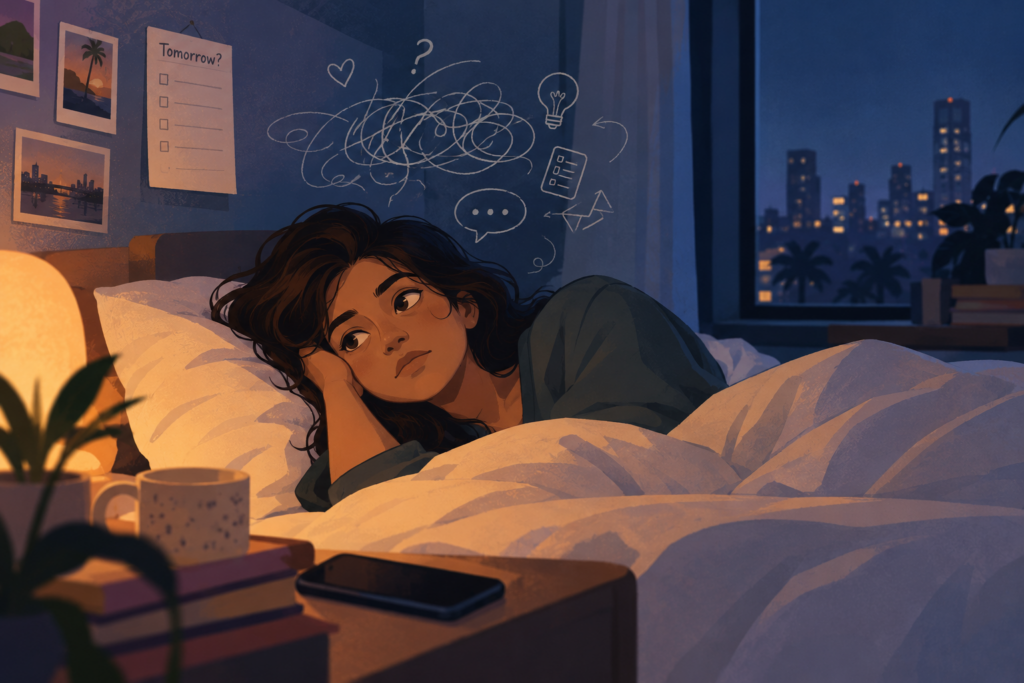
It is 1 a.m. You are exhausted, but your mind is replaying the day, planning tomorrow, and reaching for “just one more reel.” You have probably been told to “just relax” or “be more disciplined,” and somewhere along the way you may have started to believe the problem is you.

It is not. In this article, we look at why ADHD and sleep struggles so often go together, what keeps the brain “on” at night, what this can look like in everyday Indian life, what else can look similar, and what actually helps.

At Mitsu across our clinics in Mumbai, our team of mental health professionals who work with adults navigating focus, overwhelm, and emotional wellbeing often meet clients who have been treated for one thing while the real struggle is another, or both.

Why ADHD and sleep struggles often go together

Trouble sleeping is not just a side effect of a busy life. It is very common in people with ADHD, children and adults alike. Struggling to switch off at night is a brain-and-body pattern, not a character flaw.
The relationship also works both ways. ADHD can disrupt sleep, and poor sleep can worsen attention, mood, and impulsivity. After a bad night, focus dips, emotions feel bigger, and everything feels harder, so it can look like your ADHD has suddenly got “worse.”
Many adults have never been diagnosed, and for them, chronic sleep trouble is often the first thing they notice.
A quick note: not everyone who sleeps badly has ADHD, and this article is not meant for self-diagnosis.

Why is it so hard to switch off at night

There is rarely one single reason. Here are the most common ones.

A Body Clock That Runs Late : Many people with ADHD have a delayed sleep-wake rhythm. Your brain feels alert and switched on late at night, and sleepiness arrives much later than it “should.” This is why “just go to bed earlier” rarely works. You can lie down at 10 p.m., but your body simply is not ready yet.

A Busy, Restless Mind : During the day, activity and distractions keep your mind occupied. At night, they fall away, and suddenly there are racing thoughts and a long list of unfinished mental to-dos. Quiet time becomes the brain’s chance to “catch up,” and it often does so loudly.

Hyperfocus and the Need for Stimulation After Dark : It is easy to get absorbed in a show, a game, work, or your phone at night, and to lose track of time completely. For many people with ADHD, boredom is also hard to tolerate. Lying still in a dark, quiet room can feel almost unbearable, so the brain looks for something more interesting.

Revenge Bedtime Procrastination : After a long, demanding day, the late-night hours may be the only time that feels like yours. Staying up to claim some “me time” is common among working professionals, students, and caregivers. The cost shows up the next morning, which then makes the next day even more demanding.

Emotional Wind-Up : Many people with ADHD feel emotions intensely. Rejection sensitivity, stress, and the day’s mistakes can replay in your head the moment the lights go off. It is hard to rest when your mind is busy going over what you said, what you missed, or what you should have done.

Other Contributors

• Caffeine timing, including that late-afternoon chai or coffee
• Irregular routines and varying wake-up times
• Late dinners
• Medication timing, which is worth discussing with your prescribing doctor rather than changing on your own

Does this sound like you?

• You feel exhausted but wired at bedtime
• You scroll to avoid the quiet
• You feel most alert and creative after 11 p.m.
• You dread mornings
• You have tried to “fix” your sleep many times, and nothing sticks
If you nodded along to several of these, it may be worth exploring further, gently and without self-blame.

What does this look like in everyday life

Sleep struggles do not happen in a vacuum. For many people in India, the context makes them harder to spot and harder to fix:

• Late-night calls with global teams, and work that follows you home
• WhatsApp and Instagram scrolling that stretches “five minutes” into an hour
• Exam pressure and late-night study habits that start in school
• Shared rooms, joint-family noise, and late meals
• Women carrying a high mental load through the day, with the night as the only time that feels like their own

There is also limited awareness and some stigma around adult ADHD and mental health. As a result, sleep struggles are often blamed on “bad habits” or a lack of willpower, and people end up blaming themselves instead of understanding their brain.

How poor sleep feeds back into ADHD symptoms

One bad night is manageable. But when it repeats, a cycle can form:

1. You sleep late, or sleep poorly.
2. The next day brings low focus, irritability, forgetfulness, and low motivation.
3. You lean on more caffeine and more screen time to get through the day.
4. Evening arrives, your mind is wired again, and the cycle repeats.
This is not a sign that you are failing. It is a loop, and loops can be interrupted with small, realistic changes.

What does research say?

Research over the past few decades has consistently found that sleep difficulties are common in people with ADHD. Studies describe delayed sleep timing, trouble falling asleep, and poorer sleep quality, and they suggest the link runs in both directions.

Two Indian studies point the same way. Both looked at children, because Indian research on adults is still limited.

  • A 2022 case-control study in Brain Sciences, by researchers at Jindal Global University and AIIMS New Delhi, found that 65% of children with ADHD had a sleep disorder, compared with 17% of controls.
  •  Another study compared children with ADHD to their healthy siblings and found more sleep-related problems in the children with ADHD, mainly in the area of dyssomnias.

One important note: a screening questionnaire or a sleep tracker reading is not a diagnosis. Only a qualified professional can assess whether ADHD is part of the picture.

What else can look like this?

Trouble switching off at night has many possible causes, and ADHD is only one of them. Other things that can look similar include:
• Anxiety, depression, trauma, burnout, and chronic stress
• Sleep disorders such as insomnia, sleep apnoea, and restless legs
• Thyroid or hormonal changes
• Too much caffeine, or irregular schedules
Symptoms alone cannot confirm ADHD, which is why a proper assessment matters. It helps you understand what is really going on and get support that actually fits.

What usually helps

Gentle Ways to Wind Down
The goal is to work with your brain, not against it. Think of these as experiments, not rules. Pick one or two to begin with.

  1. A “landing” routine, not a strict one, Aim for 30 to 45 minutes before bed with the same few cues each night, such as dimmer lights, a warm shower, and a calm playlist. Your brain learns to read these as a signal to slow down.
  2. A brain dump before bed, Write your to-do list and worries on paper. You are not solving them, just giving your mind permission to put them down until tomorrow.
  3. A screen boundary that swaps, not removes. Replace passive scrolling with lower-stimulation options such as audio, light reading, or stretching.
  4. Work with your body clock. Keep a consistent wake-up time, get some morning light, and try not to over-nap in the afternoon.
  5. A caffeine and meal cut-off that fits your day. Notice when your last chai or coffee is, and try to avoid very late, heavy dinners.
  6. Make bedtime less boring. A podcast, a calming playlist, or a body-scan audio gives your brain something to hold on to as it slows down.
  7. Set up the room. Keep it cool, dark, and quiet where possible, and use earplugs or an eye mask if you share your space.
  8. Individual therapy. Therapy can help with emotional patterns, overthinking, and building routines that suit your brain, rather than routines borrowed from someone else’s.

Be kind to yourself along the way. Progress with sleep is rarely a straight line.

Signs it might be time to get support

It may be time to reach out if:
• Sleep trouble has lasted for weeks, despite your best effort
• Work, studies, relationships, or parenting are suffering because of it
• Low mood, anxiety, or burnout keep returning
• You have always felt “wired differently” but could never explain why
Support can include an assessment, individual therapy, and a review with your doctor if you have concerns about medication and sleep. You do not need to wait until things feel unbearable.

How Mitsu approaches this

At Mitsu across our clinics in Mumbai, our approach is collaborative and tailored to each person. We start by understanding your story and, where needed, support you with a proper assessment to sort out ADHD, anxiety, sleep disturbances etc. Then we work together through individual therapy and/or psychiatry support that caters to your concerns.

Care team illustration

Need support with what you're experiencing?

If something you've read here feels relevant to you, our care team can help you understand the right next step.

Let's chat

Share

Frequently Asked Questions

Why can’t I sleep even when I’m exhausted if I have ADHD?

People with ADHD often have a late body clock and a mind that stays active when things go quiet. You can be physically tired but mentally alert, so your body is ready to rest while your brain is not. Gentle wind-down routines and a consistent wake-up time can help.

Why do people with ADHD feel more awake at night?

Many people with ADHD have a delayed sleep-wake rhythm, so alertness peaks later in the day. Fewer distractions and less pressure at night can also make it easier to focus, which feels like a burst of energy and creativity. This is common, and it is not a sign of laziness.

Can ADHD medication affect sleep?

For some people, medication timing or type can affect sleep, and for others it makes little difference. Please do not change your dose or timing on your own. Speak with your prescribing doctor about any sleep concerns so they can guide you based on your situation.

Is it ADHD or just bad sleep habits?

It can be either, both, or something else entirely. Anxiety, depression, sleep disorders, and stress can all affect sleep and focus. If trouble sleeping comes with lifelong difficulties in attention and organisation, a proper assessment from a qualified professional can help you find out.

We’re here to help

Share your details and our team will call you shortly.

Thank you - we’ve received your request

Our team will call you shortly to help you get started